In 1989, a seminary student named Wil Howie read an article about the global water crisis and felt what he could only describe as a call. He believed that clean water was not simply a matter of infrastructure, but of human dignity, of faith, of what it means to be a neighbor.
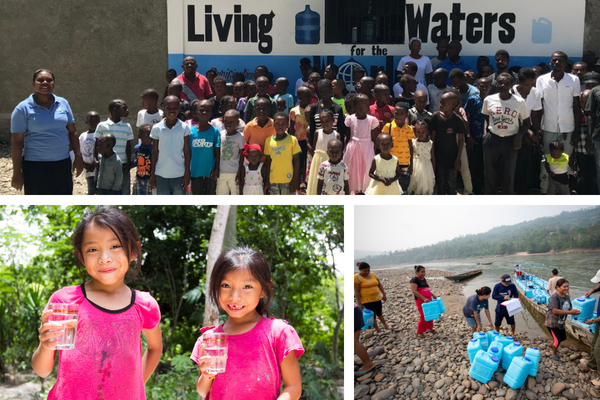
His calling ultimately became Living Waters for the World (LWW), a Christian nonprofit that trains volunteers to partner with communities around the world to install and sustain water purification systems and implement health education programs.
It would take seven years, countless hours of trial and error, and the stubbornness of a small group of Presbyterian volunteers before Howie’s calling took the form of an actual water purification system in an actual community.
In 1996, in Reynosa, Mexico, the first Living Waters for the World system came online at a health clinic operated by Puentes de Cristo, a Presbyterian Border Ministry, where nearly every ailment seen by its staff was related to poor water quality. A notable improvement occurred, and a small mission church grew up around it.
Nearly three decades later, what started as one pastor’s epiphany has grown into a global network of more than 1,100 partnerships in 28 nations and the largest expression of global witness in the Presbyterian Church (U.S.A.).
From Idea to Movement
Living Waters for the World became an official ministry of the Synod of Living Waters in 1993. But the moment that changed everything came a decade later, in a candid conversation between Howie and a small group of colleagues frustrated with the slow pace of their progress.
“Somebody said, ‘Wait, what if we trained other people on what we’ve learned over all these years? We could give them the skills quickly, rather than everyone learning through trial and error,’” recalls Steve Young, who joined the organization as a volunteer in 2001 and now serves as the organization’s long-time Executive Director.
From that conversation, Clean Water U was born. Between May 2003 and March 2004, a team of volunteers wrote a full curriculum covering water technology, health and hygiene and partnership development, raised nearly $100,000 and conducted the first training session at Hopewell Camp and Conference Center in Oxford, Mississippi.
“It’s now a familiar joke of mine to say that’s the fastest Presbyterians have moved in human history,” Young says.
That first session, promoted by word of mouth alone, drew 34 students from seven states and four denominations. “By the second day, we knew something very special was going on,” Young says. “It was a very diverse group of people who had become unified because of a higher purpose — the shared belief that all of God’s children deserve clean water to drink.”
Today, more than 2,700 volunteers have been trained through Clean Water U. The curriculum continues to evolve as lessons learned in the field flow back into the training program, creating what Young calls “a continuous improvement loop” that keeps the ministry adaptive and effective.
It’s Not About the Tech
Living Waters for the World is not the only organization working on the global water crisis. But Young is clear about what sets it apart.
“If I ever write a book about my career in mission work, it will be something along the lines of: It’s not about the tech, it’s about the people,” he says.
No LWW system has ever been installed on the first trip between partners. Before any technology is transferred, teams spend months — sometimes longer — building relationships, establishing mutual accountability and agreeing on shared commitments.
“You’re really building relationship and partnership together,” Young says. “And that’s the foundation upon which any technology or health education has got to sit. Otherwise, it will begin and end promptly.”
Unlike many water ministries that rely on U.S.-based funding directed toward contractors in the field, LWW is built on ongoing, reciprocal partnerships. Unlike drilling a well, which is a one-time intervention, water purification systems must be operated every single day. That daily commitment, Young says, makes genuine relationships not optional but essential.
Resilience, Renewal and What Comes Next
When COVID-19 grounded international travel, Young describes the experience as “your heart dropping through your toes.” The ministry’s model was built on cross-cultural, in-person relationships. Yet remarkably, very few water systems went offline during the pandemic. Indigenous staff on the ground rose to the occasion, keeping systems running and in some cases expanding production to help struggling communities.
“We learned a thing or two about letting God do things that we don’t think God can do,” Young reflects.
Looking ahead, he sees two priorities shaping the next era of Living Waters for the World. The first is system renewal — returning to long-standing partner communities to upgrade equipment and share the best practices accumulated over decades. The second is the organic emergence of locally led initiatives, where communities in countries like Haiti, Honduras and El Salvador Peru are increasingly taking ownership of the ministry for their own neighbors.
“After all, every single cup of clean water that’s produced is equally valuable,” Young says.
A Partnership Built on Shared Values
From the organization’s earliest days, Living Waters for the World’s leaders were committed to keeping their financial assets within the Presbyterian Foundation family. The relationship with New Covenant Trust Company, a subsidiary of the Foundation, has endured not out of obligation, but because of genuine alignment.
“The reason our assets are still managed by New Covenant Trust is because we apply the same principles to that relationship as we do to our ministry,” Young says.
Young describes NCTC as reliably present when questions arise, whether about investment strategy, spending policy or the complex distinctions between restricted and designated endowed funds that an organization like LWW must carefully manage. But the relationship runs deeper than technical expertise. He attributes its durability to a shared sensibility that draws people away from transactional, bottom-line-driven work toward something more relational and mission-driven.
“How they operate is a mirror of us,” Young says. “I can’t think of any other financial entity that would wave our flag as enthusiastically as they do.”
Looking further down the road, Young has no doubt the partnership will continue. “I assume absolutely that we’ll be attached to NCTC 20 years from now, as we continue to follow where God’s leading in this work.”
“Living Waters for the World is having a profound impact on communities across the world, one relationship and one cup of clean water at a time,” says Brad Masters, NCTC’s Vice President of Client Engagement. “NCTC is exceedingly grateful for and humbled by the trust LWW has placed in us to serve as their investment partner. It is because of our shared faith and values that we seek to live into our call of stewarding the financial resources, which help make this important ministry possible.”
To learn more about LWW’s mission and global impact, visit livingwatersfortheworld.org.